Tricksters and Fools
I noticed in this unit that many of the fools are foxes. Foxes are known for being sly, clever and tricksters. I think this is really apparent in this series of stories. For example in Johnny-Cake, a cake rolls (not sure how…) and outruns a series of characters. As he comes upon each character he brags about how he has outrun a father, mother, son, two well diggers, two ditch diggers and a bear. When Johnny Cake comes upon a fox he yells out his same taunt, saying he's outrun all these other people and the fox replies that he couldn't hear Johnny Cake properly. As Johnny Cake gets closer and closer, repeating his phrase, the fox finally eats him up.
(Source by John D. Batten)
In Henny-Penny, the hen, goose, duck, rooster and turkey are all tricked by the fox. They are all trying to see the king to warn him that the sky is falling. When the fox hears of their mission he promises to lead them to the king. He says that he has a shortcut through his cave. Each animal is tricked by the fox and killed, with only the hen surviving. I think both of these stories really tell a lot about how foxes are seen in many cultures. Known for being cunning and sly, in many stories I've read they trick and fool other characters.
In general, the tricksters use their tricks to eat other characters. The other characters, or the "fools" are easily convinced and gullible. They follow the fox's instruction and influence quickly, making it almost too easy for the fox to trick them. You'd think that after all these stories the animals might learn from their mistakes!
Bibliography. English Fairytales Unit by Joseph Jacobs with illustrations by John D. Batten (1890).
Showing posts with label Essay. Show all posts
Saturday, November 8, 2014
Friday, October 31, 2014
Week Twelve: Essay
First Memories of Writing
I remember when I started first grade and started to learn cursive, we always used "inventive spelling." This meant that if we didn't know how to spell something we had to write it the way we thought it should be spelled first. It taught us to sound out the word and piece together words based on our previous knowledge. Of course, I didn't always get it right. What I found most frustrating at the time was that fact that I didn't get an eraser on the end of my pencil. We had creative writing portion of school and we always had to use our "inventive spelling" without any erasers. I remember being frustrated by this and that I couldn't change what I wrote down after I wrote it. They wanted us to mark it out but still be able to draw on our changes if we wanted. I understand the idea, but when I was in second grade I didn't like the way it looked on my paper. I couldn't understand why I couldn't just erase my mistakes and re write them.
Even before that, I remember we used to retell what we learned and other stories to a teacher who would write down our ideas for us. We got to do the drawings, but the writing was physically done by someone else. That was when I was really small, maybe in kindergarden. As I moved up, we wrote down our own stories. I've read some of them and it's pretty funny to see the way I wrote and the way I spelled when I was younger.
When we learned cursive we had an outline to follow that showed us where all the letters were supposed to go, like the image below. For a long time I just had to write in cursive and even today many of my letters are still connected and curly like cursive is. I actually enjoyed cursive once I got the hang of it. It was a little difficult, but I liked it when I learned. These are my first memories of writing.
(Source)
I remember when I started first grade and started to learn cursive, we always used "inventive spelling." This meant that if we didn't know how to spell something we had to write it the way we thought it should be spelled first. It taught us to sound out the word and piece together words based on our previous knowledge. Of course, I didn't always get it right. What I found most frustrating at the time was that fact that I didn't get an eraser on the end of my pencil. We had creative writing portion of school and we always had to use our "inventive spelling" without any erasers. I remember being frustrated by this and that I couldn't change what I wrote down after I wrote it. They wanted us to mark it out but still be able to draw on our changes if we wanted. I understand the idea, but when I was in second grade I didn't like the way it looked on my paper. I couldn't understand why I couldn't just erase my mistakes and re write them.
Even before that, I remember we used to retell what we learned and other stories to a teacher who would write down our ideas for us. We got to do the drawings, but the writing was physically done by someone else. That was when I was really small, maybe in kindergarden. As I moved up, we wrote down our own stories. I've read some of them and it's pretty funny to see the way I wrote and the way I spelled when I was younger.
When we learned cursive we had an outline to follow that showed us where all the letters were supposed to go, like the image below. For a long time I just had to write in cursive and even today many of my letters are still connected and curly like cursive is. I actually enjoyed cursive once I got the hang of it. It was a little difficult, but I liked it when I learned. These are my first memories of writing.
(Source)
Saturday, October 25, 2014
Week Eleven: Essay
Alice in Wonderland: Role of Other Characters
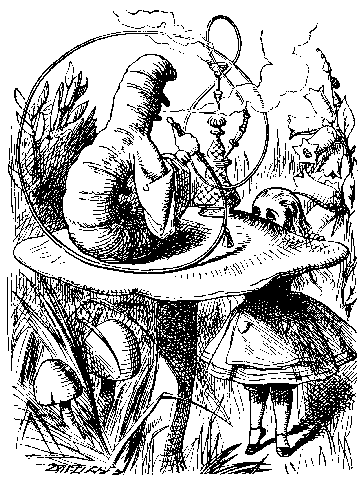
One of the more interesting stories within the Alice in Wonderland unit was the Advice from a Caterpillar story. In the story, Alice is lost and happens upon a caterpillar smoking a hookah (age appropriate?) who questions her, "Who are YOU?" She is confused and said she doesn't remember who she is or what was going on because she had been so many sizes within a short period of time. He confuses her further by his questions and mysterious, vague phrases. He made her angry and frustrated because he was confusing and made zero sense.
In my opinion, the conversation itself was completely random and deviated completely from the original question. In the middle of the conversation he tells an even more random story about an old man and a younger man asking him questions. Honestly, I wasn't sure what the point of the story was because it just abruptly ends and the story reverts back to Alice and the caterpillar.
All of the animals she encounters are strange in their own ways. By the end Alice is pretty confused by where she is and what she was doing there. I think that Alice herself is pretty strange and unusual, but that may be from being in the strange world she falls into. Or a result of the animals she encounters. She meets a pigeon and the conversation changes morphs even more. As I was reading it was actually hard to follow along because the plot doesn't seem to follow any direction. I'm not sure what the point of talking to the caterpillar and the pigeon was. I think that maybe the characters give a view into the different lifestyle and world that is present in Alice in Wonderland. Overall, I think the characters, however strange or unusual, are important in portraying the weird world that makes up her experiences. It builds the world and characters that carry on throughout the rest of the unit.
Wednesday, October 15, 2014
Week Ten: Essay
Children's Stories
What I think was the most interesting part of this collection of stories was that there was no overarching moral or lesson. Many of the children's fairytales or folktales I've read have clear lines of right and wrong. All the "bad" characters are punished while the "good" ones live happily ever after. I think this has to do with the content of these stories as well. Not all of them featured people as main characters or they weren't based around the theme of good and evil.
For example, in Shin-ge-bis Fools the North Wind, the two main characters (a man and the wind) fight over what seems to be territory. The North Wind wishes to scare off the man and make it cold everywhere and the man defeats him through heat and warmth. I wouldn't say the Wind was necessarily evil, but the South (or warm) Wind was more pleasant. Additionally, in The Boy Who Snared The Sun, the young boy kills birds and is a bit stubborn, but is not reprimanded. The Sun is freed, but the boy doesn't get any punishment for lassoing the Sun. This is interesting, because when many stories are told to children they hold a moral to somehow scare the children into being good or inspire them to be good. All the likable characters get their dreams and wishes, while the mean-spirited ones end up dead or with nothing.
However, these set of stories are far less gruesome than some I've read. I think in terms of content, they are appropriate for children's stories. The animation of animals, inanimate objects and other magical creatures is more child-friendly. Not every story is centered around a young woman getting married, as many fairytales are, so I think that aspect is good. Personally, I think children's fairytales should be fun and entertaining to hear. I don't necessarily thing they all need a moral or overarching theme, but if they do it should be encouraging and warm. Young minds are easily shaped by all sorts of experiences, so it's important to be careful with everything a child is exposed to.
What I think was the most interesting part of this collection of stories was that there was no overarching moral or lesson. Many of the children's fairytales or folktales I've read have clear lines of right and wrong. All the "bad" characters are punished while the "good" ones live happily ever after. I think this has to do with the content of these stories as well. Not all of them featured people as main characters or they weren't based around the theme of good and evil.
For example, in Shin-ge-bis Fools the North Wind, the two main characters (a man and the wind) fight over what seems to be territory. The North Wind wishes to scare off the man and make it cold everywhere and the man defeats him through heat and warmth. I wouldn't say the Wind was necessarily evil, but the South (or warm) Wind was more pleasant. Additionally, in The Boy Who Snared The Sun, the young boy kills birds and is a bit stubborn, but is not reprimanded. The Sun is freed, but the boy doesn't get any punishment for lassoing the Sun. This is interesting, because when many stories are told to children they hold a moral to somehow scare the children into being good or inspire them to be good. All the likable characters get their dreams and wishes, while the mean-spirited ones end up dead or with nothing.
(Source)
However, these set of stories are far less gruesome than some I've read. I think in terms of content, they are appropriate for children's stories. The animation of animals, inanimate objects and other magical creatures is more child-friendly. Not every story is centered around a young woman getting married, as many fairytales are, so I think that aspect is good. Personally, I think children's fairytales should be fun and entertaining to hear. I don't necessarily thing they all need a moral or overarching theme, but if they do it should be encouraging and warm. Young minds are easily shaped by all sorts of experiences, so it's important to be careful with everything a child is exposed to.
Friday, September 26, 2014
Week Nine Essay: First Memories of Reading
My first memories of reading are probably pretty cliche. My mom used to read Harry Potter to me when I was younger, so I grew up loving the series. I fell in love with the storyline and the characters and as I got older, so did they. So naturally, I went to every book and movie premiere, appropriately dressed, and cried every time a character died (Dobby, why).
That wasn't the only series I grew up with though. I also read all of the Laura Ingalls Wilder books.. And there are a lot. I loved that series. I loved the idea of growing up in the midwest during that time period when there weren't that many people. I got lost in her adventures and sense of excitement whenever they moved. I wanted to live in a log cabin so badly and make my own maple syrup candy poured on snow (which I actually did at home). I wanted to grow up in the town by the Silver Shores and meet Almanzo... The list goes on and on.
I think through my experiences of my mom reading to me and finally reading by myself, I found I have always loved reading. You can get lost in books and really live in different places, time periods and through the eyes of someone else. I have always read for pleasure, even through school, and enjoy doing that more than watching TV. I want to read all the classics, including all the books you're supposed to read in high school. I loved To Kill A Mockingbird and The Great Gatsby. In high school I read Love In The Time of Cholera and Crime and Punishment among others. I read many Jane Austen novels and am currently reading Anna Karenina.
I also enjoy some of the more recently published books. From the popular series The Hunger Games and Divergent to others like The Girl With The Dragon Tattoo and Gone Girl. As for genres, I don't have a preference. I love historical fiction though, and have enjoyed reading books by Philipa Gregory, who writes about King Henry VIII and his seven wives. Through her books I have a window into history and how events played out there. I love reading about English court and Henry's long tyrannic reign. I also like the post apocalyptic style that many of the popular series feature, because I think they pose interesting questions about the human nature and that of society. I find it fascinating to read into the idea that if everything we knew fell, how would people in power design society next and why.
That wasn't the only series I grew up with though. I also read all of the Laura Ingalls Wilder books.. And there are a lot. I loved that series. I loved the idea of growing up in the midwest during that time period when there weren't that many people. I got lost in her adventures and sense of excitement whenever they moved. I wanted to live in a log cabin so badly and make my own maple syrup candy poured on snow (which I actually did at home). I wanted to grow up in the town by the Silver Shores and meet Almanzo... The list goes on and on.
(Source)
I think through my experiences of my mom reading to me and finally reading by myself, I found I have always loved reading. You can get lost in books and really live in different places, time periods and through the eyes of someone else. I have always read for pleasure, even through school, and enjoy doing that more than watching TV. I want to read all the classics, including all the books you're supposed to read in high school. I loved To Kill A Mockingbird and The Great Gatsby. In high school I read Love In The Time of Cholera and Crime and Punishment among others. I read many Jane Austen novels and am currently reading Anna Karenina.
I also enjoy some of the more recently published books. From the popular series The Hunger Games and Divergent to others like The Girl With The Dragon Tattoo and Gone Girl. As for genres, I don't have a preference. I love historical fiction though, and have enjoyed reading books by Philipa Gregory, who writes about King Henry VIII and his seven wives. Through her books I have a window into history and how events played out there. I love reading about English court and Henry's long tyrannic reign. I also like the post apocalyptic style that many of the popular series feature, because I think they pose interesting questions about the human nature and that of society. I find it fascinating to read into the idea that if everything we knew fell, how would people in power design society next and why.
Sunday, September 21, 2014
Week Seven: Comparisons Essay
This week I read Japanese Fairy Tales and because I'm trying to get ahead (I have some crazy upcoming weeks), I already did next week's over Tibetan Folktales. Since I read them so close to together, I noticed many similarities and differences between them that I wanted to discuss here. They are both cultural fairytales, featuring magic powers, talking animals and lessons learned.
In Japanese Fairy Tales, many of the stories featured good and evil characters, each punished or rewarded for their good or bad deeds. The Envious Neighbor is punished for his devilish ways and using his neighbor's good fortune to further his own riches. And many stories featured the Japanese racoon dog, a Tanuki, and his pack of tricks and manipulations. These stories gave insight into this Japanese animal and parts of their culture that seeped into the stories.
In the The Tibetan Folktales, the stories also had similar themes and characters. Animals and humans existed together, talking and being friends or enemies. Characters were also punished for their bad intentions and rewarded for their honesty. In The Ingratitude of Man, a man helped another man, fox, rat and snake from a cliff and in return they all helped him except the man. In the end, the ingratitude of man got him arrested and imprisoned.
While all of the stories had obvious similarities among them: themes and morals of good and evil and actions punishment and reward. What differed is what interested me. While all of the Tibetan Folktales had proverbs at the beginning, they also featured a prominent sense of god or higher spiritual being. In The Violinist they open the door to hell and push the wicked king in themselves. Also in The Man and the Monkeys, after the man betrays the monkeys that helped him, the Monkey god interfered and kills the man. These signs of god and religious beliefs are present in the Tibetan Folktales, while they don't exist in the Japanese Fairy Tales. The Japanese Fairy Tales may have the same morals, but don't mention once the existence of a god that is pulling the strings above. The concept of good and evil is punished and focused on man and the earthly world, instead of guided by another being. I think this is really interesting to see within the stories. It makes me wonder about the religious views that Japan has culturally and historically had, and if these views affect their customs or traditions. Just from these stories, I would conclude that they don't, at least not as much as they do in the Tibetan tradition.
I think it's also intriguing to note that, even without these religious concepts and aspects, the Japanese fairy tales are still very similar to the Tibetan ones. Both have the same concept of good and evil, bad and good, and punishment and reward. Does that lead to the notion that these are inherently human (or animal) feelings and not originating from a religious base? Maybe some morals begin there, but it argues that even those without religious aren't without moral code. Just a few thoughts.
Overall, I enjoyed both units and thought they had a lot of interesting things to say about their respective cultures.
(Source)
(Source)
In Japanese Fairy Tales, many of the stories featured good and evil characters, each punished or rewarded for their good or bad deeds. The Envious Neighbor is punished for his devilish ways and using his neighbor's good fortune to further his own riches. And many stories featured the Japanese racoon dog, a Tanuki, and his pack of tricks and manipulations. These stories gave insight into this Japanese animal and parts of their culture that seeped into the stories.
In the The Tibetan Folktales, the stories also had similar themes and characters. Animals and humans existed together, talking and being friends or enemies. Characters were also punished for their bad intentions and rewarded for their honesty. In The Ingratitude of Man, a man helped another man, fox, rat and snake from a cliff and in return they all helped him except the man. In the end, the ingratitude of man got him arrested and imprisoned.
While all of the stories had obvious similarities among them: themes and morals of good and evil and actions punishment and reward. What differed is what interested me. While all of the Tibetan Folktales had proverbs at the beginning, they also featured a prominent sense of god or higher spiritual being. In The Violinist they open the door to hell and push the wicked king in themselves. Also in The Man and the Monkeys, after the man betrays the monkeys that helped him, the Monkey god interfered and kills the man. These signs of god and religious beliefs are present in the Tibetan Folktales, while they don't exist in the Japanese Fairy Tales. The Japanese Fairy Tales may have the same morals, but don't mention once the existence of a god that is pulling the strings above. The concept of good and evil is punished and focused on man and the earthly world, instead of guided by another being. I think this is really interesting to see within the stories. It makes me wonder about the religious views that Japan has culturally and historically had, and if these views affect their customs or traditions. Just from these stories, I would conclude that they don't, at least not as much as they do in the Tibetan tradition.
I think it's also intriguing to note that, even without these religious concepts and aspects, the Japanese fairy tales are still very similar to the Tibetan ones. Both have the same concept of good and evil, bad and good, and punishment and reward. Does that lead to the notion that these are inherently human (or animal) feelings and not originating from a religious base? Maybe some morals begin there, but it argues that even those without religious aren't without moral code. Just a few thoughts.
Overall, I enjoyed both units and thought they had a lot of interesting things to say about their respective cultures.
Friday, September 19, 2014
Week Six Essay: Assessing The Unit
I really enjoyed the Japanese Fairytales unit! I had so much fun reading and learning through these stories. They were entertaining and interesting, plus none were so extensively long that I got bogged down in the length. The morals and themes of good and evil were very prevalent, but like I mentioned in my reading diary, none of the stories referenced a God or higher being as the justice-maker. Magical powers, talking animals and underwater worlds were just completely normal and not due to any type of established religion or religious views. Evil characters were punished just because they were evil and mean, not because some higher power punished them. I thought was interesting, especially after reading Bible Women and reading other fairytales that focused a lot on that religious aspect.
Additionally, I liked learning more about how the Japanese culture was worked into the stories. I learned about a Tanuki, which is a Japanese raccoon dog (picture below). The character was usually a trickster and greedy, he was always making bad things happen to good people. In most of the stories the Tanuki was punished for his actions.
I also noticed how graphic some of the stories got. In The Slaying Of The Tanuki, he tricks a husband into eating his own wife! And in The Crab And The Monkey, the monkey beats the crab almost to death. The evil characters are pretty brutal with their jokes and many sell out their own family or spouses, like in How The Wicked Tanuki Was Punished and The Sparrow With The Split Tongue. In many of the other culture fairytales the evil characters aren't always direct family or spouses, so it's interesting that the bad characters come from so close.
I really enjoyed reading this unit and had the opportunity to see the Japanese culture through the lens of the stories. I learned about a new animal and got to see how the evil and good themes are represented in the stories.
Additionally, I liked learning more about how the Japanese culture was worked into the stories. I learned about a Tanuki, which is a Japanese raccoon dog (picture below). The character was usually a trickster and greedy, he was always making bad things happen to good people. In most of the stories the Tanuki was punished for his actions.
(Source)
I also noticed how graphic some of the stories got. In The Slaying Of The Tanuki, he tricks a husband into eating his own wife! And in The Crab And The Monkey, the monkey beats the crab almost to death. The evil characters are pretty brutal with their jokes and many sell out their own family or spouses, like in How The Wicked Tanuki Was Punished and The Sparrow With The Split Tongue. In many of the other culture fairytales the evil characters aren't always direct family or spouses, so it's interesting that the bad characters come from so close.
I really enjoyed reading this unit and had the opportunity to see the Japanese culture through the lens of the stories. I learned about a new animal and got to see how the evil and good themes are represented in the stories.
Friday, September 12, 2014
Week Five Essay: Role of Women in The Turkish Fairytales
I think what's most interesting to me is how similar the plots in the stories are. Even though there were around 17 different tales, many had similar plots and characters. Most started with a son, or poor man, who runs across a beautiful fish, bird or other animal. The animal then turns into a beautiful maiden (either immediately or eventually) and the King wishes to marry or take the maiden for himself. The King then puts impossible tasks before the young man, who finds help from his magical animal-maiden and completes them. In The Fish-Peri, he has to build a beautiful palace, a crystal bridge, hold a huge feast and find a talking infant. All of these he finds and helps him win back his beautiful maiden, who he promptly marries. In The Crown-Peri, the young man must win back his fish-maiden by bringing in ivory trunks and the bird's fairy-Queen owner. After satisfying the King he gets to marry the bid, who has turned into a woman. The Wizard-Dervish details the story of a young man who finds himself captured by a Dervish and three doves (who, naturally, are women). One dove-woman in particular helps him choose a wife (her) and escape the Dervish's beatings.
These themes are present in many of the stories in this unit and give insight into how the Turkish cultural values and history. The female always acts as an advice-giver. helping the man through his troubles. I'm not exactly sure why she doesn't start in human form, always as an animal, but maybe it contributes to the magical theme of the tales. Maybe, the male characters need to get to know the female characters (as animals) first to get the help they need, before they marry them. I found these stories interesting and entertaining to read. The magical and mythical aspects made the stories more dynamic, however, I noticed that many did not have an overall theme or moral at the end, like some fairytales do.
Wednesday, September 3, 2014
Week Four Essay: Future of Written Media
I'm excited about what's coming next for media. Since I'm in public relations, I see a lot of where the industry is going and how people will communicate in the future. What amazes, interests and intrigues me specifically, is social media. Aside from normal daily use, I've had experience using many platforms for business purposes. Learning about target audience, reach and how to attract visitors has been exciting and interesting for me as a student and young professional. Using social media for personal reasons is much different from business use, and it has made me more aware of how businesses are implementing social media plans to reach their marketing goals.
What I think is most exciting is the platforms themselves. I've seen so much creativity and innovation from brands on Snapchat, Twitter and Instagram. Who knew brands like Taco Bell and Urban Outfitters had Snapchats, and successfully reach their target audience through detailed stories and audience engagement on this platform? I think what is so cool about social media is the parameters that confine each post. If you only had 140 characters to reach your audience, foster engagement and get your message across, what would you say? It forces PR professionals and creatives to get to the point, be selective with language and really understand their audience. It's exciting to be challenged like this, and I'm really interested in the direction that social media is taking public relations.
I always feel so nerdy, but I love when brands interact with each other on Snapchat, especially some of my favorite brands. Behind each Twitter account is some creative team, working to carve out a personality online. They have to be engaging, funny and original, and this really shines through when they interact with each other. I think it's exciting to see -- almost like two of your good friends becoming friends.
I don't know if social media will always be around, but I think that communication and media is going in this direction. We can't go back from it now, and even if Facebook isn't here in 20 years, something will replace it and it will be shorter, more interactive and more engaging. These platforms are hard, because there's so much clutter to fight through, but also an excellent opportunity to directly reach readers. I think the future of media is going towards digital, and I hope to be there helping businesses connect with their audiences.
What I think is most exciting is the platforms themselves. I've seen so much creativity and innovation from brands on Snapchat, Twitter and Instagram. Who knew brands like Taco Bell and Urban Outfitters had Snapchats, and successfully reach their target audience through detailed stories and audience engagement on this platform? I think what is so cool about social media is the parameters that confine each post. If you only had 140 characters to reach your audience, foster engagement and get your message across, what would you say? It forces PR professionals and creatives to get to the point, be selective with language and really understand their audience. It's exciting to be challenged like this, and I'm really interested in the direction that social media is taking public relations.
(Source. Just a sample of the types of things they promote on Snapchat. They also have voting competitions and other engagement opportunities.)
I always feel so nerdy, but I love when brands interact with each other on Snapchat, especially some of my favorite brands. Behind each Twitter account is some creative team, working to carve out a personality online. They have to be engaging, funny and original, and this really shines through when they interact with each other. I think it's exciting to see -- almost like two of your good friends becoming friends.
I don't know if social media will always be around, but I think that communication and media is going in this direction. We can't go back from it now, and even if Facebook isn't here in 20 years, something will replace it and it will be shorter, more interactive and more engaging. These platforms are hard, because there's so much clutter to fight through, but also an excellent opportunity to directly reach readers. I think the future of media is going towards digital, and I hope to be there helping businesses connect with their audiences.
Thursday, August 28, 2014
Week Three Essay: Writing Experience
In high school I completed the International Baccalaureate Program, which focused on overarching themes throughout the school year and taught us how to analyze, think and question things we learned in each class. Similar to AP, but in my opinion more difficult, it was less about memorizing facts and dates, and more about exploring the whys and hows of history, english, social studies and math. Our testing was all purely essay as well, with the exception of sciences and math, which featured some short answer in addition to multiple choice.
For instance, my senior IBHL english class focused on the theme of love. Every book we read had this theme and throughout our time we wrote plenty of essays analyzing the colors, characters, motifs, etc. All of this culminated in a end-of-the-year test that was part written part oral, where we basically had an hour to write an analysis of a book passage and explain it to our teacher. Through this course, and my other IB classes, I learned a lot about writing essays about literature. I learned how to recognize and analyze elements within a novel, connect these themes to other stories and create well-written and lengthy essays in a short amount of time.
With the exception of college credit, none of this helped me when I came to OU.
Not to discredit my high school, I thought the IB program was a great opportunity. I got the best teachers, had classes with the best students and learned a lot of skills I use today. But, my writing has definitely changed since then.
I remember my first journalism writing class; Writing for Mass Media. I had to throw out everything I'd learned in an English class (namely, Oxford commas), and relearn how to use punctuation, when to use abbreviations and how to properly list states. It was a huge change for me and that class was not only difficult, but a huge learning experience. I hated that class while I was in it, but now I am thankful I learned AP style and know basic rules that I am now expected to know. I like the way I write now better anyway. Less fluff, more information. At least that's the journalistic way.
I enjoy being able to read a newspaper or magazine and see the same rules and concepts put into play there. They write and follow the same rules as I do and they are "in the real world." I think the essay writing I did in high school served me well and taught me many things. The IB program challenged me to think harder, delve deeper and question more often than I would have, but college has taught me a more practical, applicable style of writing that I use today.
(Source)
For instance, my senior IBHL english class focused on the theme of love. Every book we read had this theme and throughout our time we wrote plenty of essays analyzing the colors, characters, motifs, etc. All of this culminated in a end-of-the-year test that was part written part oral, where we basically had an hour to write an analysis of a book passage and explain it to our teacher. Through this course, and my other IB classes, I learned a lot about writing essays about literature. I learned how to recognize and analyze elements within a novel, connect these themes to other stories and create well-written and lengthy essays in a short amount of time.
With the exception of college credit, none of this helped me when I came to OU.
Not to discredit my high school, I thought the IB program was a great opportunity. I got the best teachers, had classes with the best students and learned a lot of skills I use today. But, my writing has definitely changed since then.
I remember my first journalism writing class; Writing for Mass Media. I had to throw out everything I'd learned in an English class (namely, Oxford commas), and relearn how to use punctuation, when to use abbreviations and how to properly list states. It was a huge change for me and that class was not only difficult, but a huge learning experience. I hated that class while I was in it, but now I am thankful I learned AP style and know basic rules that I am now expected to know. I like the way I write now better anyway. Less fluff, more information. At least that's the journalistic way.
(Source)
I enjoy being able to read a newspaper or magazine and see the same rules and concepts put into play there. They write and follow the same rules as I do and they are "in the real world." I think the essay writing I did in high school served me well and taught me many things. The IB program challenged me to think harder, delve deeper and question more often than I would have, but college has taught me a more practical, applicable style of writing that I use today.
Monday, August 25, 2014
Week Two Essay: Female Characters In The Bible
It's not necessarily surprising, but it was interesting to me the way women were portrayed in many of these stories. The first part, specifically, featured many stories that revolved around men with some female characters. Mostly sidelined as wives, child bearers and handmaids, women in stories like Rebekah and Rachel have a heavy focus on a primary male character. The woman's job is primarily to give birth to children and when she can't, she finds a way to give him sons anyway.
Furthermore, when women were unfavored by God, they were deemed barren and couldn't please their husbands with children. I think these stories show a lot about the priorities and circumstances in society during this time period (and for a long time after that as well) about how women were seen and treated. In Hannah, she is first barren and is so distraught she prays for days until she conceives. However, Hannah's husband's other wife, Peninnah, has children. In many of the stories (including Leah) one of the wives is cursed by being barren and the other has the Lord's favor, and has children. This creates a rivalry and pits wives against each other, each competing to have the most children -- especially sons. There were no stories of female friends, they only interacted in competition, which was an interesting point to the female relationships in the stories.
However, the second part of the Bible Women Unit portrayed women very differently. They are given more power, legitimized and used to seek advice. The same traditional themes of marriage, children and husbands are present, but other, more complicated story lines arise. In Susannah, she is almost sentenced to death because she is accused of cheating by two elders. At first her perspective isn't given any merit, but after an angel descends and clears the situation she is redeemed and seen as honest. Susannah is given a central part and portrayed in a positive, virtuous way.
I think that these common themes are associated with woman in many time periods and cultures. Seen primarily as child bearers, women throughout history have been sidelines to the desires and needs of men. These stories are an interesting take on the roles and responsibilities of women. I think it's interesting to read about how these roles and relationships have changed and evolved over time.
Furthermore, when women were unfavored by God, they were deemed barren and couldn't please their husbands with children. I think these stories show a lot about the priorities and circumstances in society during this time period (and for a long time after that as well) about how women were seen and treated. In Hannah, she is first barren and is so distraught she prays for days until she conceives. However, Hannah's husband's other wife, Peninnah, has children. In many of the stories (including Leah) one of the wives is cursed by being barren and the other has the Lord's favor, and has children. This creates a rivalry and pits wives against each other, each competing to have the most children -- especially sons. There were no stories of female friends, they only interacted in competition, which was an interesting point to the female relationships in the stories.
However, the second part of the Bible Women Unit portrayed women very differently. They are given more power, legitimized and used to seek advice. The same traditional themes of marriage, children and husbands are present, but other, more complicated story lines arise. In Susannah, she is almost sentenced to death because she is accused of cheating by two elders. At first her perspective isn't given any merit, but after an angel descends and clears the situation she is redeemed and seen as honest. Susannah is given a central part and portrayed in a positive, virtuous way.
I think that these common themes are associated with woman in many time periods and cultures. Seen primarily as child bearers, women throughout history have been sidelines to the desires and needs of men. These stories are an interesting take on the roles and responsibilities of women. I think it's interesting to read about how these roles and relationships have changed and evolved over time.
Subscribe to:
Posts (Atom)